
Your 2027 Plan Assumes Capacity Your Bank Doesn’t Have
 Bank capacity planning often starts with a flawed assumption: that the team is 100% available. It never is.
Before any new project gets the green light, a big part of the bank's delivery capacity is already tied up in work that can't be skipped. In the portfolios we review, that's usually 35 to 45 percent.
New projects must fight for whatever capacity is left. If the plan doesn't account for that, the numbers only work on paper.
What Types of Work Compete for Bank Capacity?
A strategic portfolio needs a balance of three types of work:
- Run the Bank: regulatory requirements, risk management, cybersecurity, business continuity, and other mandatory work. None of it is optional.
- Improve the Bank: cost reduction, process improvement, digital transformation, technology modernization, AI and automation, and customer experience.
- Grow the Bank: new products, markets, channels, and partnerships, M&A, and anything else that could generate revenue.
The right mix varies by institution. What shouldn’t vary is the discipline of bank capacity planning across all three.
Why Is Mandatory Work a Capacity Tax?
Regulatory obligations, critical risk fixes, and cybersecurity aren't optional. But being required doesn't make them free. This work draws on the same limited group of people as everything else, so it needs to be visible in the portfolio.
I think of it as a capacity tax. It gets paid first, before any discretionary project can move forward.
Treat Run the Bank work as a capacity commitment, not an optional investment, and keep it separate from projects meant to improve or grow the bank. Technology modernization mostly belongs under Improve the Bank, where you can weigh its value, urgency, risk, and expected return.
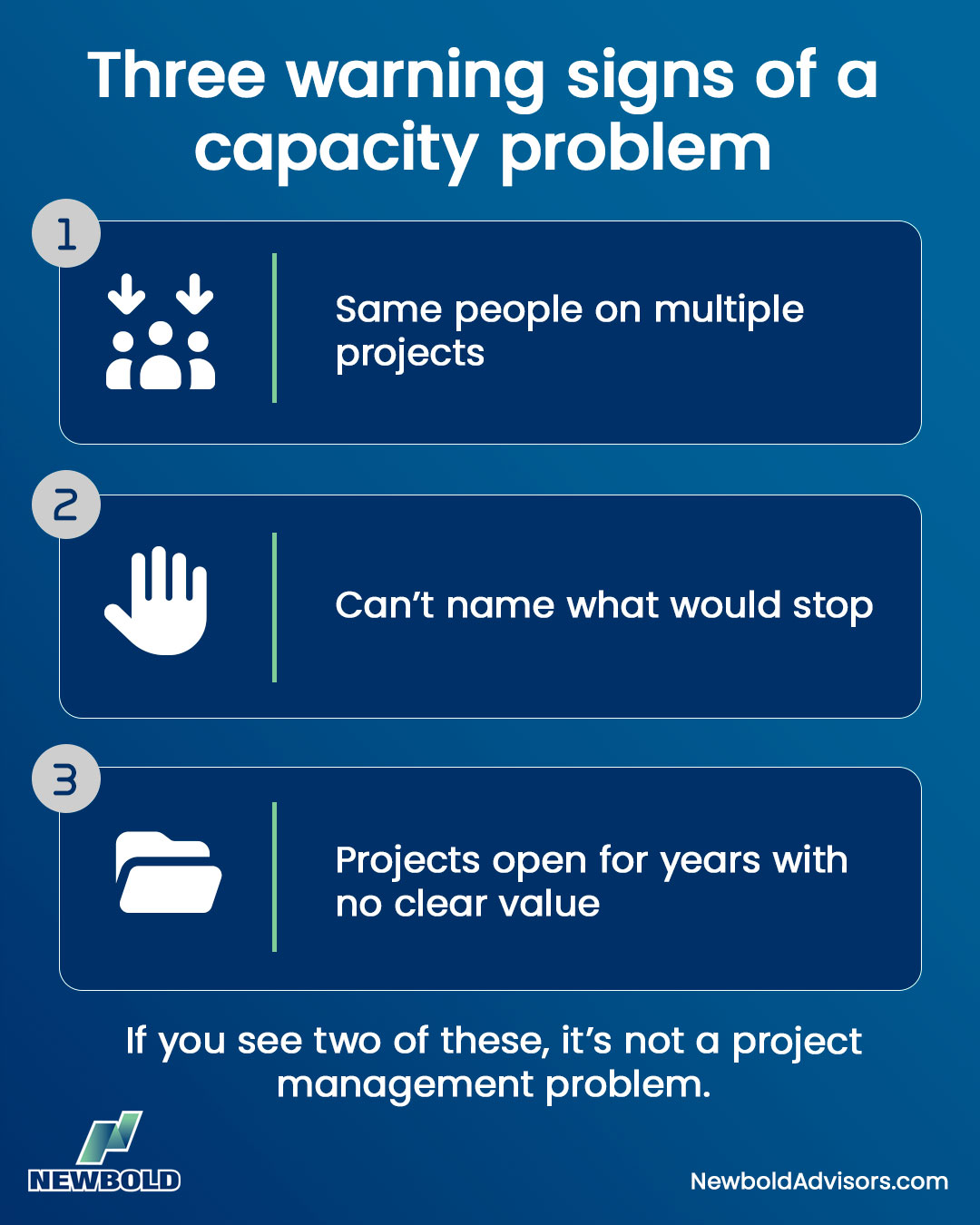
3 Warning Signs of a Bank Capacity Planning Problem
When a portfolio takes on more than the bank can handle, three warning signs usually show up:
- Projects miss milestones because the same people support several initiatives at once.
- Business leaders can't say which initiatives would stop if resources were cut.
- Strategic projects stay open for months or years absent clear evidence of business value.
When this happens, the problem usually isn't project management. It's portfolio capacity.
Ignoring it has a real cost. Overloaded teams slow down, burn out, and leave. The bank leans harder on expensive outside resources. Benefits slip. Tactical investments compete. The bank spends more and achieves less.
AI Won't Free Up Capacity Until You Free Up Capacity for AI
AI shows up in almost every 2027 plan as a way to get more done with the same people. The catch is that those same people have to build it first.
Every AI project leans on the same small group of people: data and IT, model risk and governance, compliance, vendor management, and the business leaders who must redesign the actual work. Add three AI pilots to an already full portfolio, and you haven't created efficiency.
You've just given the same people three more projects to juggle.
In one portfolio review, we found six overlapping automation pilots across four business units. Each competed for the same technology, data, risk, and compliance teams, and none included a decision about what to stop or defer.
Banks that see real returns from AI will treat it like any other portfolio investment. They'll connect each use case to a strategic goal, measure the capacity it uses, and decide what it will replace.
The better question is which AI projects are worth giving something else up to deliver.
Effective bank capacity planning treats capacity as a constraint from the beginning, not something you discover in the second quarter when milestones start slipping. That means knowing how much strategic work your people, technology, capital, and leadership can absorb after paying the capacity tax.
Bank Capacity Planning FAQs
Check Your Portfolio
Start your bank capacity planning with our 10-question Portfolio Capacity Checklist. It takes about five minutes and shows where your bank is most stretched.